Table of Contents
The End of an Era: Your #1 Google Rank is Worthless
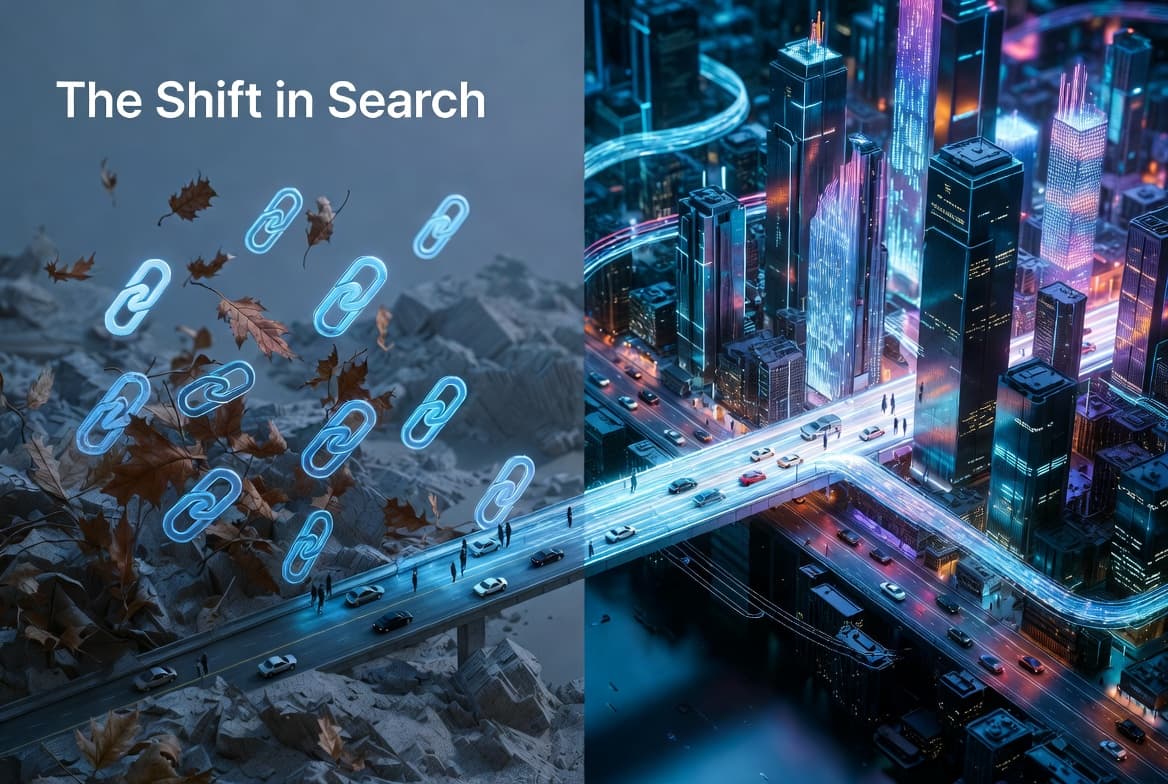
For two decades, the rules were simple: rank on Google, get traffic, win. That era is over. The slow decay of organic reach has become a catastrophic collapse, and the culprit is AI. The "ten blue links" are a nostalgic relic. If you are still obsessing over them, you are optimizing for a ghost town.
The game is no longer Ranking—it is Retrieval. AI-powered Answer Engines like Perplexity, Google's AI Overviews, and SearchGPT have become the new front door to the internet. They don't "search" your site; they use Retrieval-Augmented Generation (RAG) to retrieve "chunks" of text from a vector database that are semantically similar to a user's prompt. If your content is buried in marketing fluff, its vector embedding becomes "noisy," and the RAG system discards it.
This is not a "future" trend. It is an extinction event for content that isn't optimized for machines. This guide is your survival plan.
What is Generative Engine Optimization (GEO)?
Generative Engine Optimization (GEO), also known as Answer Engine Optimization (AEO), is the practice of structuring and enhancing your digital content to be easily found, understood, and cited by AI language models (LLMs) in their generated answers. Unlike traditional SEO which targets keyword rankings, GEO targets direct inclusion and recommendation within AI-generated summaries. It prioritizes Information Gain—the delivery of unique, verifiable data—over keyword repetition.
The GEO Matrix: How AI "Personalities" Differ
You can't use the same strategy for all three. They are different beasts.
| Feature | SearchGPT (The Visual Synthesizer) | Perplexity (The Academic Aggregator) | Claude (The Semantic Reasoner) | ChatGPT (The Consensus Engine) |
|---|---|---|---|---|
| Source Logic | Reranked Bing Index & Visuals | Authority & Freshness | Safety & Contextual Depth | Popularity & Training Data |
| Kill Factor | Lack of structured data | Paywalls or slow site speed | Negative sentiment/Risky topics | Lack of broad web mentions |
| Optimization | High-quality charts, <table> | Data tables & "Updated" timestamps | Deep-dive whitepapers | "Top 10" listicle mentions |
| Hallucination Risk | Low (cited) | Low (cited) | Medium (refuses to answer) | High (invents features) |
- SearchGPT: Prioritizes structured data and visual assets. GEO Tactic: Embed high-quality charts and use strictly formatted lists.
- Perplexity: Heavily weighs Domain Authority and Freshness. GEO Tactic: Maintain a rigorous "Last Updated" protocol and publish unique data.
- Claude: Excels at long-context understanding. GEO Tactic: Publish deep-dive technical documentation and whitepapers.
- ChatGPT: Relies on "Probabilistic Truth." GEO Tactic: Build brand ubiquity across 3rd-party review sites.
From "Blog Posts" to "Knowledge Objects"
The era of the "1,500-word narrative blog post" is fading. LLMs struggle to extract facts from fluff. 2025 demands Knowledge Objects—atomic, highly-structured, extractable content units designed for RAG ingestion.
The Difference: A blog post tells a story. A Knowledge Object defines an entity.
How to Build a Knowledge Object:
-
Structure: Use Key-Value Pair formatting.
-
Bad (Narrative):
"When looking at our pricing, we offer a flexible tier that starts at..." -
Good (RAG-Ready):
"Pricing Model: SaaS Subscription. Entry Cost: $49/mo. Commitment: Monthly." -
The "TL;DR" Box: Add a summary box at the start of your articles with hard stats. Perplexity and SearchGPT scrape this first.
-
Data Tables: Convert all comparisons and feature lists into clean HTML
<table>elements. LLMs ingest tables instantly.
Why it Works: This dramatically lowers the "computational cost" for the AI to parse your data, increasing the probability it will be retrieved and cited. Studies show listicles and comparison tables are cited 3.2x more often than narrative prose.
Case Study: The "Invisible" Market Leader
We tracked a major CRM tool ("SaaS-X").
- ChatGPT: Recommended SaaS-X immediately because it was in its 2023 training data.
- Perplexity: Did not recommend SaaS-X. Why? Because SaaS-X's blog was gated behind a login, and their pricing page was a PDF. Perplexity couldn't read it, so it recommended a smaller competitor with a clear HTML pricing table.
The Lesson: You can be famous and still be invisible to AI if your technical accessibility is poor.
The SaaS Survival Checklist (2025 Edition)
- The "Brand" Test: Ask ChatGPT "What is [Your Brand]?" If it hallucinates or says "I don't know," your Entity Confidence is failing. Update your Wikipedia/Crunchbase/About Page immediately.
- The "Unique Data" Test: Do you have proprietary data? If you are just summarizing other people's content, SearchGPT will summarize them, not you. You must own the source data to provide high Information Gain.
- The "Technical" Audit: Is your site renderable by a headless browser? If your content is locked behind complex JS that the Perplexity bot can't execute, you don't exist.
- The "Citation Score" Strategy: Get mentioned on .gov sites, university research, or in major news outlets. When Perplexity sees your domain linked from a "High Trust" bucket, your Citation Probability skyrockets.
- The "Dark Matter" Analytics: Stop relying on GA4. It misses the 95% of AI interactions that are zero-click. Use a tool like SGS Pro to track your "Share of Model" (SoM)—how often you are cited vs. your competitors. If your SoM is low, your revenue will eventually follow.
Conclusion: Adapt or Die
The "traffic hose" from Google is drying up. User behavior has changed irreversibly. They want answers, not homework. GEO isn't a "nice to have"—it is the only way to ensure your SaaS remains discoverable in a world where the search engine does the reading for the user. If you aren't optimizing for the machine, you are optimizing for a ghost town.